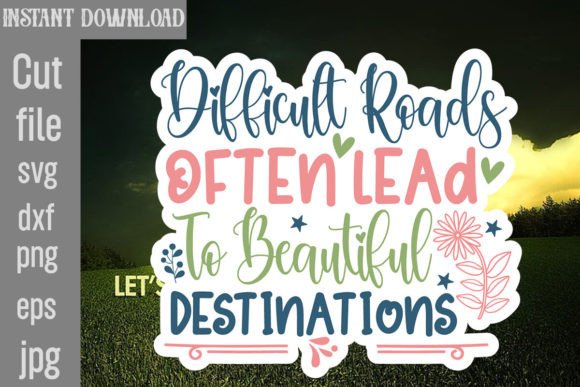
Reviewing Difficult Roads Often Lead to Beautiful
As a designer who has spent years digitizing and stitching thousands of patterns, I have learned that the most powerful designs are not always the most complex. Sometimes, a simple phrase paired with thoughtful typography carries more weight than an intricate floral motif. Recently, I evaluated Difficult Roads Often Lead to Beautiful, a digital asset that bridges the gap between inspirational messaging and visual craftsmanship. This review is written from the perspective of someone who needs to know how a design performs under the needle, not just how it looks on a screen.
The first impression of this piece is one of resilience and calm. The layout suggests a journey, likely incorporating winding paths or organic lines that guide the eye through the text. For embroidery designers and small business owners, this mood is crucial. It fits naturally into the current market demand for mindful, mental-health-aware, and motivational Crafts. When I opened the files, my immediate focus was on scalability and stitchability. Since this is a DIGITAL DOWNLOAD ONLY product, the quality of the source files determines the success of the final embroidery project.
Real-World Application: The Custom Tote Bag Test
To truly understand the value of this design, I imagined a specific client request: a custom embroidered tote bag for a local bookstore’s loyalty program. The client wanted something that felt literary yet rugged, appealing to readers who enjoy hiking and outdoor adventures. Difficult Roads Often Lead to Beautiful was the perfect candidate. However, translating a digital concept into a tactile handmade product requires careful planning.
I started by examining the included files. The package provides a versatile suite of formats: one SVG file for Cricut, one DXF file for Silhouette, one EPS vector file, and one PNG file with a transparent background at 300 DPI. For an embroiderer, the SVG and EPS files are particularly valuable. They allow me to import the design into my digitizing software to create a proper machine embroidery design. The PNG is excellent for creating printable mockup images for Etsy listings or social media previews before I even thread the machine.
When visualizing this on a canvas tote, I considered the fabric texture. Canvas is sturdy, but it has a weave that can swallow fine details. If the original graphic relies on thin, delicate lines, I would need to adjust the stitch density and use a satin stitch or a slightly thicker running stitch to ensure visibility. The phrase itself is long, so spacing becomes critical. On a standard tote, centering the design works well, but if the "roads" element is wide, I might need to scale it down to fit within a 5x7 or 6x10 hoop without losing legibility.
Versatility Across Product Lines
Beyond tote bags, this design shows promise in several other categories. For custom apparel, such as a heavyweight sweatshirt, the design could serve as a chest pocket accent or a larger back print. Sweatshirt embroidery requires attention to stabilizer choice; a cut-away stabilizer is essential to prevent the fabric from puckering under the weight of the stitches. The inspirational nature of the quote makes it ideal for holiday embroidery gifts, particularly for graduates or anyone undergoing a life transition.
For Etsy sellers and craft business owners, versatility is key to profitability. This design could be adapted into an embroidered patch using a dense fill stitch and a merrowed edge. Patches are low-risk items for testing new designs because they do not require hooping the garment itself. If the design includes curved elements representing the "roads," these must be digitized with care to avoid thread breaks on tight curves. The EPS vector file allows for precise manipulation of these curves before digitizing, ensuring smooth satin columns.
In the realm of baby embroidery, caution is advised. While the message is beautiful, the length of the text might be too small to read clearly on a onesie unless significantly scaled up, which might exceed the hoop size. However, for a nursery pillow cover or a blanket border, where space is less constrained, the design could add a touching, personalized element. Always consider the end user: will this be washed frequently? If so, simplify the stitch types to ensure durability.
Technical Considerations for Embroiderers
It is important to note that this product provides Graphics files, not necessarily a pre-digitized embroidery file like PES or DST. This distinction is vital for commercial embroidery professionals. You will need to digitize the design yourself or hire a digitizer. This is actually an advantage for experienced makers, as it allows full control over thread colors, stitch angles, and underlay settings. You can tailor the design to match your brand’s aesthetic perfectly.
When working with the SVG or DXF files in your digitizing software, pay close attention to the small details. Tiny serifs or intricate road textures may not translate well to thread. I recommend simplifying these areas. Use a running stitch for fine outlines and reserve fill stitches for larger shapes. Check the hoop size compatibility early. If the design is wide, ensure your machine can handle the width, or consider splitting the design if appropriate, though continuous phrases are best kept intact for readability.
Testing on scrap fabric is non-negotiable. Stitch out the design on the same type of fabric you plan to use for the final finished product. Observe how the thread colors interact with the fabric background. High contrast is usually best for readability, especially with a phrase of this length. If using dark fabric, consider using a lighter thread or adding a white underlay to make the colors pop. For textured fabrics like towels or fleece, increase the stitch density slightly to prevent the fabric from showing through the stitches.
Enhancing Brand Value and Customer Trust
Using high-quality source files like those provided in this download elevates the perceived value of your small shop product. Clean vectors mean clean edges in your digitizing, which leads to professional-looking stitches. Customers can spot sloppy embroidery from a mile away. By taking the time to properly convert and test Difficult Roads Often Lead to Beautiful, you demonstrate professionalism and care. This builds trust and encourages repeat business.
For digital product sellers who offer both physical and digital goods, this asset is dual-purpose. You can sell the physical embroidered item and use the PNG file to create digital wall art prints or sublimation designs, expanding your revenue streams. Just ensure you understand the licensing terms included with the download. Most commercial use licenses allow you to sell physical items made with the design, but reselling the digital file itself is typically prohibited. Always read the specific license agreement provided by the creator.
In conclusion, Difficult Roads Often Lead to Beautiful is a strong contender for makers looking to add meaningful, motivational pieces to their portfolio. Its strength lies in its emotional resonance and flexible format. By approaching it with a designer’s eye—considering stitch density, fabric choice, and hoop constraints—you can transform this digital graphic into a stunning tangible item. Whether for a personalized gift or a boutique inventory staple, this design rewards careful execution with a high-impact result.